

The New AI Economy

The New AI Economy: Who Gets Rich and Who Gets Left Behind?
Most articles about “the AI economy” are written as if it’s still hypothetical: a thought experiment about robots and jobs, decades away. It isn’t. By the start of 2026, the four largest US cloud companies had already lifted combined data-center spending by roughly 78% year over year, and analysts at Dell’Oro pushed the 2026 global data-center capex forecast past $1 trillion for the first time. Goldman Sachs, in a research note published this spring, sketched out something even larger: roughly $7.6 trillion in cumulative AI infrastructure capital expenditure between 2026 and 2031.
That money has to come from somewhere, and it has to go somewhere. This piece is about both directions: who is capturing the gains, who is absorbing the costs, and — the part most coverage skips — the messy middle ground where the same person can be a winner in one role and a loser in another, sometimes within the same year.
The misconception: “AI winners” means tech companies, “AI losers” means everyone else
This is the framing you’ll see in 80% of the headlines, and it’s not wrong so much as it’s two years out of date. In 2023 and 2024, the AI economy really did look like a two-sided story: a handful of chipmakers and cloud platforms versus “the workforce.” That framing made sense when AI was mostly a story about model releases and stock prices.
It stopped making sense around the time the layoffs started showing up in companies that have nothing to do with selling AI. Workday — a human-resources software company — cut about 1,750 jobs, roughly 8.5% of its workforce, explicitly to redirect spending toward AI investment. That’s not a tech company losing to AI. That’s a company spending money on AI by cutting the people who’d normally administer HR software. The categories are blurring.
Who’s actually getting rich: the infrastructure layer
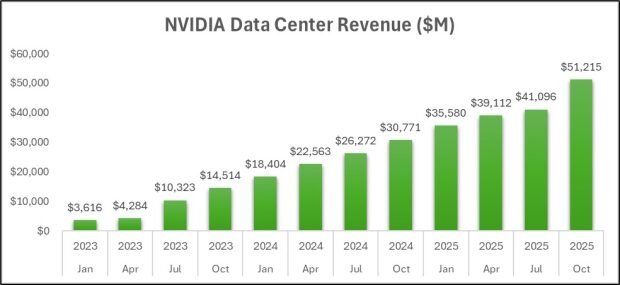
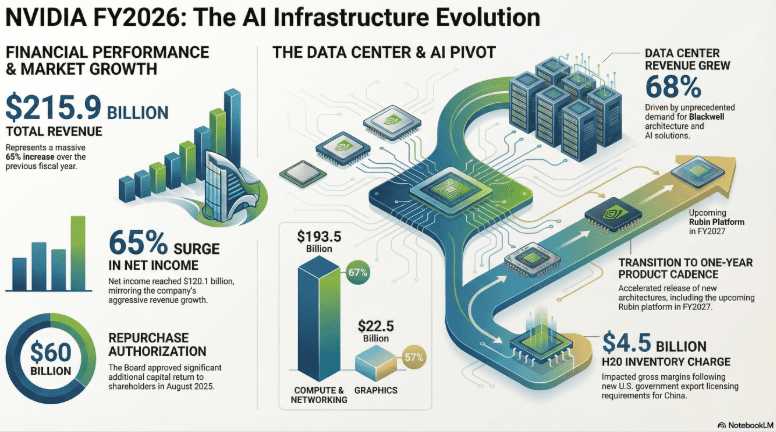
Start with the part that’s easiest to measure, because it shows up in quarterly earnings calls rather than survey data. Nvidia’s fiscal year ending January 2026 closed with $215.9 billion in total revenue, up 65% year over year, with data-center revenue alone hitting $197.3 billion — nearly double the prior year’s figure. By the first quarter of the new fiscal year, data-center revenue had climbed again to a record $75.2 billion, up 92% from a year earlier, driven by the ramp of new Blackwell-generation systems.
Here’s the number that matters more than any of those, though: hyperscalers — Amazon, Microsoft, Google, and Meta — now account for roughly half of Nvidia’s data-center revenue, with the other half spread across “AI clouds,” sovereign government buyers, and enterprise customers. That diversification is itself a signal. The AI economy’s money isn’t just flowing from a handful of Silicon Valley giants anymore; entire national governments are now line items.
But — and this is where the “infrastructure = automatic winner” story gets its first crack — the same boom that’s filling Nvidia’s order book is doing the opposite to the free cash flow of the companies buying the chips. Wall Street estimates cited by industry analysts suggest free cash flow at major Big Tech companies could fall by as much as 90% in 2026 as capital spending outpaces the revenue that spending generates. Jensen Huang’s framing — that this is “not going to go back,” that the buildout will keep expanding from here — is also, by definition, the sentence every infrastructure salesperson says at the top of every cycle. He might be right. He’s also the person with the most to gain if everyone believes him.
The choke points: where the real leverage sits in 2026
If you’re trying to figure out who benefits from the next phase of this buildout — rather than the phase that already happened — the more useful question isn’t “who makes AI chips” but “what’s the physical bottleneck right now.” As of mid-2026, that list has gotten longer and less glamorous than “GPUs”:
| Bottleneck | Why it matters now | Who benefits |
|---|---|---|
| High-Bandwidth Memory (HBM) | Every new accelerator generation needs more memory bandwidth than the supply chain can currently produce | Memory manufacturers, packaging specialists |
| Advanced packaging (CoWoS and similar) | Chips can be fabricated faster than they can be assembled into finished modules | Foundry packaging divisions, equipment makers |
| Electrical power and grid capacity | Data centers are now competing with cities for substations and transmission capacity | Utilities, power-equipment manufacturers, sites with existing grid access |
| Industrial cooling | Rack densities have outpaced air cooling; liquid cooling is now standard for top-tier systems | Cooling and thermal-management suppliers |
| Inference-optimized custom silicon | As usage shifts from training to running models for customers, cost-per-query starts to matter more than raw training speed | Companies designing custom AI accelerators for cloud providers |
That last row is the one I’d watch most closely if I were allocating money rather than writing about it. There’s a real shift happening — quiet, not yet fully priced in by most retail investors — from “who has the most training compute” toward “who can run inference cheaply at scale.” Industry analysis from mid-2026 points out that this shift favors efficiency and throughput over headline training benchmarks, which changes the economics of who wins — and it’s a much less photogenic story than “biggest model wins,” which is exactly why it’s underpriced.
The correction: AI isn’t replacing “jobs.” It’s replacing the moment someone gets hired
Here’s the part of the story that gets buried under layoff headlines, and it’s the part that actually explains the data better. The Federal Reserve’s Beige Book — a qualitative survey of business conditions across US regions — has repeatedly noted something specific: firms aren’t necessarily firing existing staff because of AI. They’re not backfilling roles that become vacant. Entry-level hiring, junior analyst positions, customer-support roles, back-office functions — these are being quietly absorbed by existing staff who are now “augmented,” and the open req just… doesn’t get reposted.
That distinction matters enormously for how this feels on the ground. A mass layoff is visible — it’s a news story, a press release, a number. A hiring freeze on entry-level roles is invisible. There’s no event. There’s just a graduating class that sends out 200 applications and hears nothing back, and nobody can point to a single decision that caused it.
“Output per hour has risen faster than total hours worked. In plain English, the economy is producing more output without needing more labor.” — observation drawn from recent productivity data, as reported by InvestorPlace in May 2026
The labor-market data backs this up in an oddly specific way. Looking at US Bureau of Labor Statistics figures, white-collar unemployment — management, professional, and office roles — has risen every year since 2023. Blue-collar unemployment, in construction and maintenance trades, has stayed flat or declined over the same period. That’s close to the opposite of what most people would have predicted five years ago, when “learn to code” was the default advice and trade work was framed as the thing AI would eventually automate.
The sectors named most often as exposed — and this list is worth reading slowly if you work in any of them — are marketing, legal, accounting, human resources, and IT. Notice what these have in common: they’re all roles built around producing, reviewing, or routing information — exactly the category of work a language model is good at, even an imperfect one.
A nuance almost nobody mentions: the college-degree premium hasn’t disappeared — it’s just being earned differently
Between January 2000 and April 2026, workers with only a high school diploma averaged a 5.7% unemployment rate, compared with 3.2% for bachelor’s-degree holders. That gap hasn’t closed. But the reason a degree helps is shifting — it’s increasingly a signal of “can work alongside AI tools effectively” rather than “can do tasks AI can’t do yet.” Those are very different kinds of insurance, and the second kind has a shorter shelf life.
The geoffrey hinton problem: when the “godfather of AI” tells you he’s worried
It’s easy to dismiss AI-doom commentary as marketing — fear sells subscriptions, and “AI will take your job” headlines have been written since at least 2016. But Geoffrey Hinton’s recent comments are worth taking seriously precisely because of his track record on capability timelines, which has tended to run ahead of consensus rather than behind it.
In a televised interview, Hinton described a specific scaling pattern: roughly every seven months, AI systems double the length of the task they can complete end-to-end without human intervention. He traced the progression from “a minute’s worth of coding” to “whole projects that are like an hour long” — and extrapolated that within a few years, systems could handle software engineering projects spanning months, with correspondingly fewer people needed to supervise them.
What’s notable is what Hinton singled out as a potential winner: healthcare. His reasoning wasn’t “AI will replace doctors” — it was that efficiency gains for doctors could expand access to care, meaning more patients served per clinician rather than fewer clinicians needed. That’s a genuinely different model of “AI winner” than the chipmaker story: not a company capturing revenue, but a sector where the same number of skilled humans, multiplied by AI tools, can serve a much larger population. If that pattern holds in other licensed, judgment-heavy professions — certain legal specialties, certain engineering roles — it suggests the safest professional ground isn’t “AI can’t do this” but “AI makes me serve more people, and someone still has to be accountable for the outcome.”
He also dismissed universal basic income as an adequate response — not on cost grounds, but because, in his view, it doesn’t address the loss of dignity and purpose that comes with not working. Whatever your politics, that’s a more interesting critique than the usual UBI debate, because it reframes the problem as social and psychological rather than purely financial.
The numbers people actually search for: how big is this, really?
Layoffs.fyi-tracked technology-sector layoffs hit roughly 32,000 in just the first two months of 2026 — and 2025 had already seen around 55,000 layoffs explicitly attributed to AI by outplacement firm Challenger, Gray & Christmas, out of 1.17 million total layoffs, the highest level since the 2020 pandemic. That AI-attributed figure is a small fraction of the total — which tells you something important: AI is currently more of an accelerant and justification for workforce reductions that have multiple causes (inflation, interest rates, post-pandemic overhiring corrections) than the sole cause on its own. Companies cite AI because it sounds forward-looking in a press release. The actual driver is often broader cost discipline.
That doesn’t make it less real for the people affected. It does mean that “AI took my job” and “my job was cut during a broader restructuring that AI made easier to justify” are often the same event described two different ways — and the second framing is more useful if you’re trying to figure out what to do next, because it points at the actual decision-making process inside companies rather than at the technology itself.
What Blackstone’s president told his own investors — and why it’s more candid than most CEO talk
In a presentation to investors, Blackstone president Jon Gray reportedly opened with a clip from The Graduate — the famous scene where a young man is pulled aside at his graduation party and given career advice that, in hindsight, completely missed where the economy was heading. The point of the reference was explicit: every major technological shift reshuffles the labor market in ways that seem obvious only after the fact — farmers became factory workers, and “encyclopedia salesman” became “software developer” became, perhaps, something we don’t have a name for yet.
What’s striking is that this came from the president of a private-equity firm — an institution whose entire business model is buying companies, restructuring them, and selling them at a profit. When the person running that kind of operation tells investors that AI is a once-in-a-generation reshuffling, it’s not really a prediction. It’s closer to a description of his own firm’s strategy. Gray noted Blackstone’s own portfolio value had grown from roughly $10 billion at the time of a 2021 acquisition to around $70 billion — and he’s positioning that growth narrative as evidence the AI-driven reshuffle has already started paying off for capital allocators, well before it’s visible in most people’s careers.
So who, specifically, is winning right now? A practical breakdown
Strip away the speculation about 2030 and look only at what’s happening in 2026, with money already changing hands:
| Category | Status in 2026 | Why |
|---|---|---|
| Chip and infrastructure suppliers (Nvidia and the supply chain around it) | Winning, decisively, on revenue | Demand from hyperscalers and sovereign buyers still exceeds supply for top-tier accelerators |
| Capital allocators (private equity, large asset managers) | Winning | Positioned to acquire undervalued assets and restructure around AI-driven efficiency before labor markets fully reprice |
| Skilled trades (electricians, HVAC, construction) | Winning, somewhat unexpectedly | Physical buildout of data centers requires enormous amounts of on-site skilled labor that can’t be automated yet |
| Senior professionals with accountability + AI fluency | Winning relative to peers | Can supervise AI output at scale; the “accountable human” role doesn’t disappear, it just oversees more output per person |
| Entry-level white-collar workers (marketing, legal support, junior analysts) | Losing ground | Tasks are routine enough for AI, and the “training pipeline” role these jobs used to serve is being skipped entirely |
| Big Tech free cash flow (short-term) | Under pressure | Capex is outpacing realized revenue; this is a cost today for a bet on tomorrow |
| Mid-sized software vendors without an AI moat | At risk | Customers increasingly ask “why pay for this when a general AI tool does 80% of it” |
The harder question nobody’s answering yet
Every source above is confident about the next twelve months. None of them are confident about what happens after the buildout phase ends — and it will end, because data centers, unlike software, take years to build and then sit there for a decade or more. Goldman’s $7.6 trillion estimate explicitly depends on assumptions about how long AI chips remain economically useful before they’re replaced — and small changes to that “useful life” assumption move the total by hundreds of billions of dollars.
Here’s the scenario almost nobody is pricing in conversationally, even though it’s sitting right there in the Goldman methodology: what happens to the “AI economy winners” narrative if the chips being installed in 2026 are functionally obsolete by 2029, while the buildings, power contracts, and cooling systems around them are only halfway through their useful life? You’d get an economy that has already paid the labor cost (the jobs that didn’t get backfilled, the entry-level pipeline that didn’t form) without yet collecting the productivity benefit that was supposed to justify it. That’s not a prediction — it’s a gap in the current discourse, and it’s worth watching for in 2027 earnings calls, not 2026 ones.
What this means if you’re not a hyperscaler or a private equity firm
Most practical advice in this space is either too vague (“learn AI skills”) or too narrow (“learn to prompt”). Based on everything above, three things hold up better than generic advice:
First, the safest professional positioning right now isn’t “AI can’t do my job” — almost nothing is permanently safe from that claim — it’s “I’m the accountable person when AI gets it wrong.” That’s true in healthcare, in regulated finance, in law, in engineering sign-offs. The work itself may shrink, but the accountability role doesn’t disappear; it just covers more output per person.
Second, if you’re early-career, the absence of entry-level hiring isn’t a signal to wait it out — historically, hiring freezes that look temporary in year one tend to become structural by year three, because the people who would have trained you also stop existing as a role. Building a portfolio of demonstrable, AI-assisted output that proves you can supervise and improve AI work — not just produce it — is a more durable signal than a credential alone.
Third, and this is the unglamorous one: the skilled-trades data isn’t a fluke. The physical AI buildout — power, cooling, construction, maintenance — is a multi-year, geographically distributed labor demand that doesn’t compete directly with AI capability the way information work does. It won’t make headlines the way “AI replaces lawyers” does, but it’s one of the few categories in this entire analysis with unambiguous, sustained demand growth backed by hundreds of billions of dollars in committed capital.
One honest caveat before you act on any of this
Everything in this article is accurate as of June 2026, sourced from earnings filings, Federal Reserve commentary, and reporting from the past few months. Two years ago, an article like this would have under-counted how fast hyperscaler capex would grow and over-counted how quickly “AI agents” would replace skilled coding work. The pattern in both cases was the same: the financial numbers moved faster than predicted, and the labor-market numbers moved slower and more unevenly than predicted. There’s no reason to assume that pattern reverses. If you’re making a career or investment decision based on an article — this one included — the only durable strategy is checking whether the underlying numbers have moved again since it was written, because they will have.